
The Southern Coast of Sri Lanka
Sri Lanka's southern coast is not one destination. Travelling east from Bentota, around the island's southern edge and on towards Hambantota, you pass through resort towns and working cities, fishing villages and surf villages, lagoons, rainforest country and long stretches of palm-fringed beach.
For a first visit, the useful thing is understanding how these places differ from one another — which is simpler than it first appears.
This is what we would tell a friend before they came.
The towns along the southern coast
Bentota, Balapitiya and Hikkaduwa
Bentota is one of the established resort areas of the south-west, known for its broad beach and the river that meets the sea beside the town. Hotels of every size run north and south along the coast from there.
Just south, Balapitiya is the access point for the Madu Ganga — an internationally recognised wetland of mangrove channels and small islands, and a quiet morning out by boat.
Further on, Hikkaduwa is one of the coast's longest-established visitor towns, long associated with its reef, with surfing, and with a well-established scene of bars and restaurants along its beach road.
Galle
Galle is the historic city of the southern coast, and the anchor of any trip here.
The fortified old town was founded by the Portuguese in the sixteenth century and developed substantially under Dutch rule in the seventeenth. The Old Town of Galle and its Fortifications has been a UNESCO World Heritage Site since 1988.
It is not a preserved ruin. People live inside the walls, and the streets hold shops, galleries, cafés, museums and small hotels alongside houses, churches and a working lighthouse. An evening walk on the ramparts is what many visitors remember.
The Galle and Matara districts are also closely associated with Ceylon cinnamon.
Unawatuna to Koggala
East of Galle the coast strings together a series of smaller places: Unawatuna, Dalawella, Talpe, Habaraduwa and Koggala.
The character changes here. Instead of resort strips you find bays, headlands, private villas, boutique hotels and quieter stretches of sand. Koggala adds a different landscape again, with a large lagoon lying just inland from the sea.
For visitors who would rather not stay in a resort but want Galle, the beaches and the inland villages within easy reach, this is the part of the south that tends to suit.
Ahangama, Midigama and Weligama
These three are strongly associated with surfing.
Weligama has a long bay and a substantial concentration of surf schools and accommodation, while the reef and point breaks further west are better known among experienced surfers.
Away from the water, the area has a developed scene of cafés, restaurants, guesthouses and villas, with straightforward road access to Galle, Matara and inland.
Mirissa and Matara
Mirissa has grown from a fishing village into one of the better-known visitor towns of the south, with a beach, a working harbour, restaurants and accommodation from guesthouses up to larger hotels. It also has one of the more active evening scenes in the deep south.
Matara, further east, is a different proposition — one of the principal cities of southern Sri Lanka and a working regional centre with markets, banks, shops and transport connections. It is useful as a practical stop as much as a destination.
Dondra and the southern tip
Dondra sits beside the southernmost point of mainland Sri Lanka.
Its landmark is Dondra Head Lighthouse, which at 49 metres is the tallest in Sri Lanka, standing over the headland above the sea.
The land around Dondra also marks a change. West of here the country is green and wet; east of here it opens out and dries.
Dickwella and Tangalle
Continuing east brings you to Dickwella and then Tangalle.
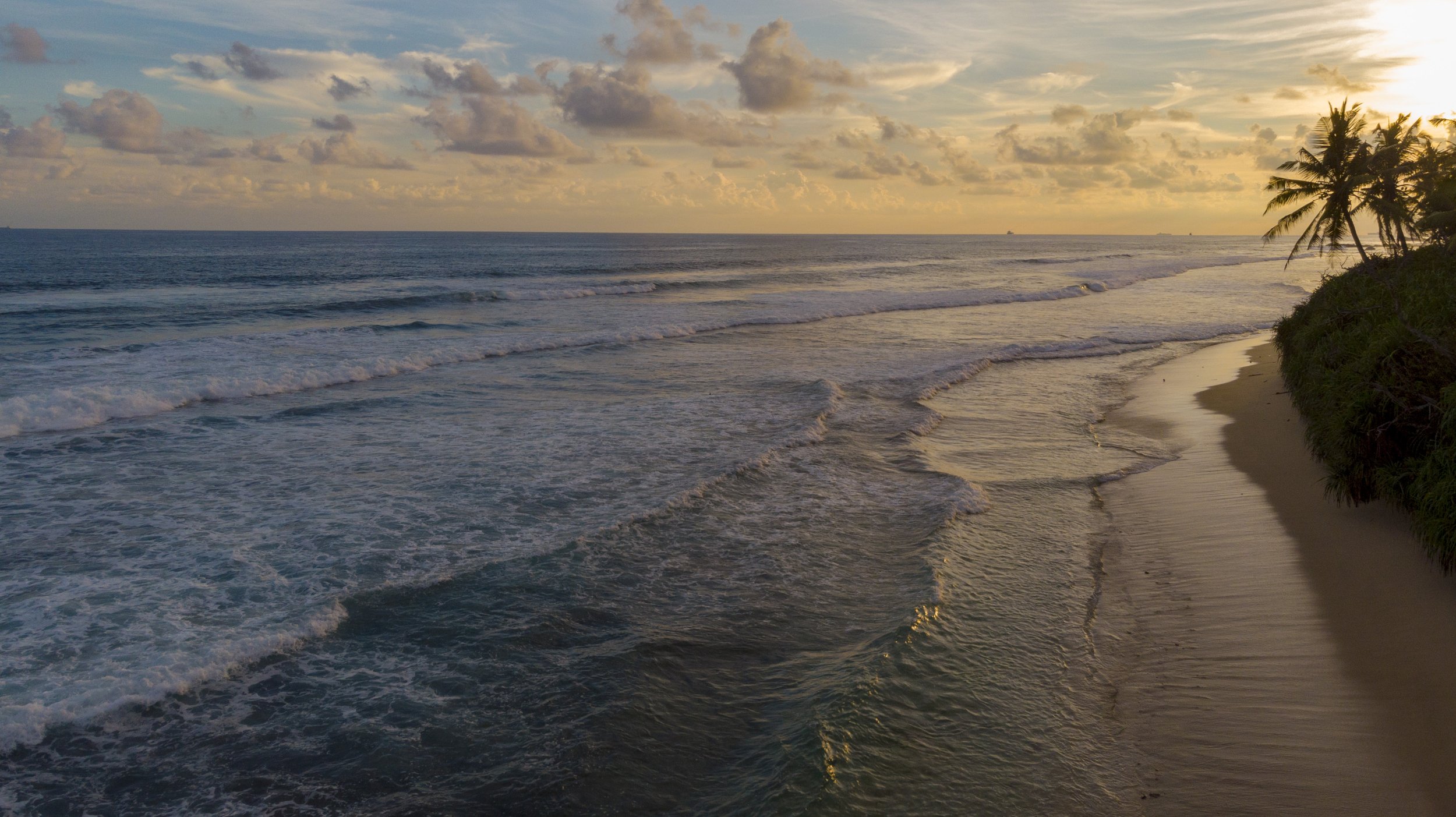
This coastline is bays, rocky headlands, coconut palms and long sandy stretches, with accommodation running from small guesthouses to villas and resorts. Tangalle itself spreads across several separate bays rather than forming a single beachfront.
Inland from Tangalle, Mulkirigala rock temple is arranged across several terraced levels of a rock outcrop, with shrines and cave spaces at each.
This stretch feels markedly less built-up than the Galle–Matara corridor, though individual towns vary.
Hambantota and the dry south-east
Around Hambantota the landscape opens out into Sri Lanka's dry zone — scrub, saltpans, lagoons and wide skies, with a light and a scale quite unlike the green coast behind you.
The region is the gateway to the south-east: wildlife parks, coastal wetlands and pilgrimage sites. Nearby Tissamaharama is the usual base for trips to Yala, Bundala and Kataragama.
Things to do beyond the beaches
The coast brings most visitors here, but some of the south's best experiences are inland.
Wildlife. Udawalawe National Park, established in 1972 around a reservoir, is one of Sri Lanka's most significant elephant habitats, with grassland, scrub and woodland supporting elephants alongside many other mammals, reptiles and birds. Yala, further east, holds forest, scrub and wetland habitats and is particularly associated with Sri Lankan leopards. Bundala, near Hambantota, is an internationally recognised wetland and an important site for migratory shorebirds, with lagoons, saltpans, marshes and dunes. All of this wildlife is free-ranging, so no particular sighting can be promised.
Rainforest. Inland from the south-west lies Sinharaja Forest Reserve, one of Sri Lanka's most important surviving areas of primary tropical rainforest, and both a UNESCO World Heritage Site and a Biosphere Reserve. It is particularly important for endemic plants, birds, amphibians and other wildlife. It is wet, dense and best walked with a guide who knows the birdsong.
Temples and pilgrimage. Kataragama, inland from Tissamaharama, is among the island's most significant pilgrimage destinations. Visitors to any religious site should dress modestly and follow local practice on footwear and photography.
Food, markets and spices. Local markets sell fruit, vegetables, seafood and spices by the sackful, and the food is reason enough to come. Rice and curry here means half a dozen dishes arriving at once. Cinnamon has a particularly strong association with the southern districts, and small-scale handloom weaving continues around Galle.
Stilt fishing. You will have seen the photograph before you arrive. The practice belongs to this stretch of coast around Koggala and Ahangama, and the poles standing out in the shallows are a familiar part of the landscape here.
Nightlife, restaurants and live music
Much of this coast keeps its evenings low-key — a long dinner somewhere small, and not a great deal of noise after it. Three places are the exception, and they offer three quite different nights out.
Hikkaduwa
Hikkaduwa has the longest-running nightlife on the southern coast. The beach road is lined with bars and restaurants, many of them opening straight onto the sand, and live music is a regular fixture rather than an occasional event. Informal beach gatherings and parties are a regular part of the town, especially around weekends. If a lively night out is part of what you are looking for, Hikkaduwa is well set up for it.
Mirissa
Mirissa is the other end of the coast's nightlife, and the more convenient of the two for visitors staying further south. Restaurants put tables out on the sand as the light goes, some of the beachfront restaurants display fresh seafood for guests to select, and a number of the bars run live music and DJ nights. It is a compact bay, so the whole scene is walkable from end to end in a few minutes.
Galle Fort
The Fort offers something different again, and it suits a long dinner rather than a late night. Restaurants and rooftop bars occupy converted Dutch-era houses inside the walls, the streets stay quiet, and you can walk the ramparts afterwards.
Unawatuna and Weligama both have beachfront bars and casual restaurants as well, with Weligama's scene following the surf crowd and running at a gentler pace than either Hikkaduwa or Mirissa.
Traditional dance and drumming performances are also part of the cultural life of the south, arranged by hotels and venues at different times.
Where to stay on the southern coast
Accommodation along the southern coast covers a wide range.
Bentota and the established coastal areas have the larger resorts. Galle Fort has boutique hotels and converted historic houses inside the walls, which is a particular kind of stay — quiet after dark, everything on foot. Beach towns such as Hikkaduwa, Unawatuna, Weligama and Mirissa have hotels, guesthouses and small independent places across a broad range of prices.
Private villas are common along parts of this coast, particularly between Galle and the villages further east. These range from a few rooms to whole houses taken exclusively, often with staff and a cook. Depending on the property, they can suit couples, families or groups who would rather have the run of a house and eat breakfast in their own garden.
What a villa includes varies from property to property, so it is always worth asking the owner or manager directly. Advance booking can be useful during busier periods.
Getting to the south coast, and getting around
By air. Bandaranaike International Airport at Katunayake, north of Colombo, is the arrival point for most international visitors. Mattala Rajapaksa International Airport near Hambantota also handles international operations.
By road. The expressway network has transformed road travel to the south. From Bandaranaike International Airport at Katunayake, the route follows the Colombo–Katunayake Expressway, connects with the Outer Circular Highway and then joins the Southern Expressway, allowing traffic bound for Galle, Matara and destinations further east to bypass central Colombo. The expressway network has substantially reduced road travel times to many southern destinations.
By train. The Coast Line runs south from Colombo through Galle and Matara and continues to Beliatta, following the shoreline closely for long stretches. It is one of the more memorable train journeys in the region, and Sri Lanka Railways publishes the current timetables and services.
Choosing where to base yourself
It is possible to move along the coast every night or two, though many visitors find that one base serves them better.
A base around Galle, Unawatuna or Talpe puts the historic city, the beaches, the inland villages and the towns out towards Weligama and Mirissa all within comfortable reach of a single place. It also sits between the two kinds of evening — the Fort in one direction, Mirissa in the other — which means you can go out when you want to and still come back to somewhere quiet. Further east, Tangalle serves as a base for the quieter south and for trips towards Hambantota and the wildlife parks.
The places along this coast tend to reveal themselves slowly — the market on a particular morning, the ramparts at the right hour, a stretch of beach you only find because you walked a little further than you meant to. A few unhurried days in one place generally shows you more of the south than a week of driving between towns.
Before you travel
The southern coast is best understood as a collection of distinct places rather than one continuous resort strip. There are working cities and historic streets, popular beach towns and small fishing communities, surf villages, lagoons, rainforest, wildlife parks, pilgrimage sites and long stretches of tropical coastline.
Choose the parts that match the trip you want, allow enough time to see them without rushing, and check weather, transport and access close to the date.
Then leave some room in the plan. That tends to be where the good days come from.
Royal Indigo Villa is a four-bedroom beachfront villa at Talpe, between Galle and Koggala, on the stretch of coast described above.
Disclaimer
This article is published for general information and interest only and is intended to provide basic background information about Sri Lanka’s southern coast. It reflects our understanding at the time of writing and should not be relied upon as advice or as a recommendation of any kind. Places, services, facilities, access arrangements, opening hours, transport options, local conditions and other information may change and may have changed since publication. Royal Indigo Villa does not operate or control any third-party business, operator, venue, attraction, service or form of transport mentioned or referred to in this article, and nothing in this article should be taken as an endorsement or recommendation of any such third party. Royal Indigo Villa gives no warranty that the information is complete, current or accurate and accepts no responsibility or liability for any loss, cost or inconvenience arising from its use. Please make your own enquiries and seek appropriately qualified advice where necessary before making travel plans or decisions. Nothing in this article forms part of any booking, reservation or accommodation agreement.