
The Food of Southern Sri Lanka
Sri Lankan food does not travel as widely as the food of its neighbours, which means most visitors arrive without much idea of what is coming. That is a good way to arrive. Few people leave the southern coast without a list of things they want to eat again.
What follows is a brief description of what you will meet at the table here, and why it tastes the way it does.
Rice and curry is not a dish — it is a table
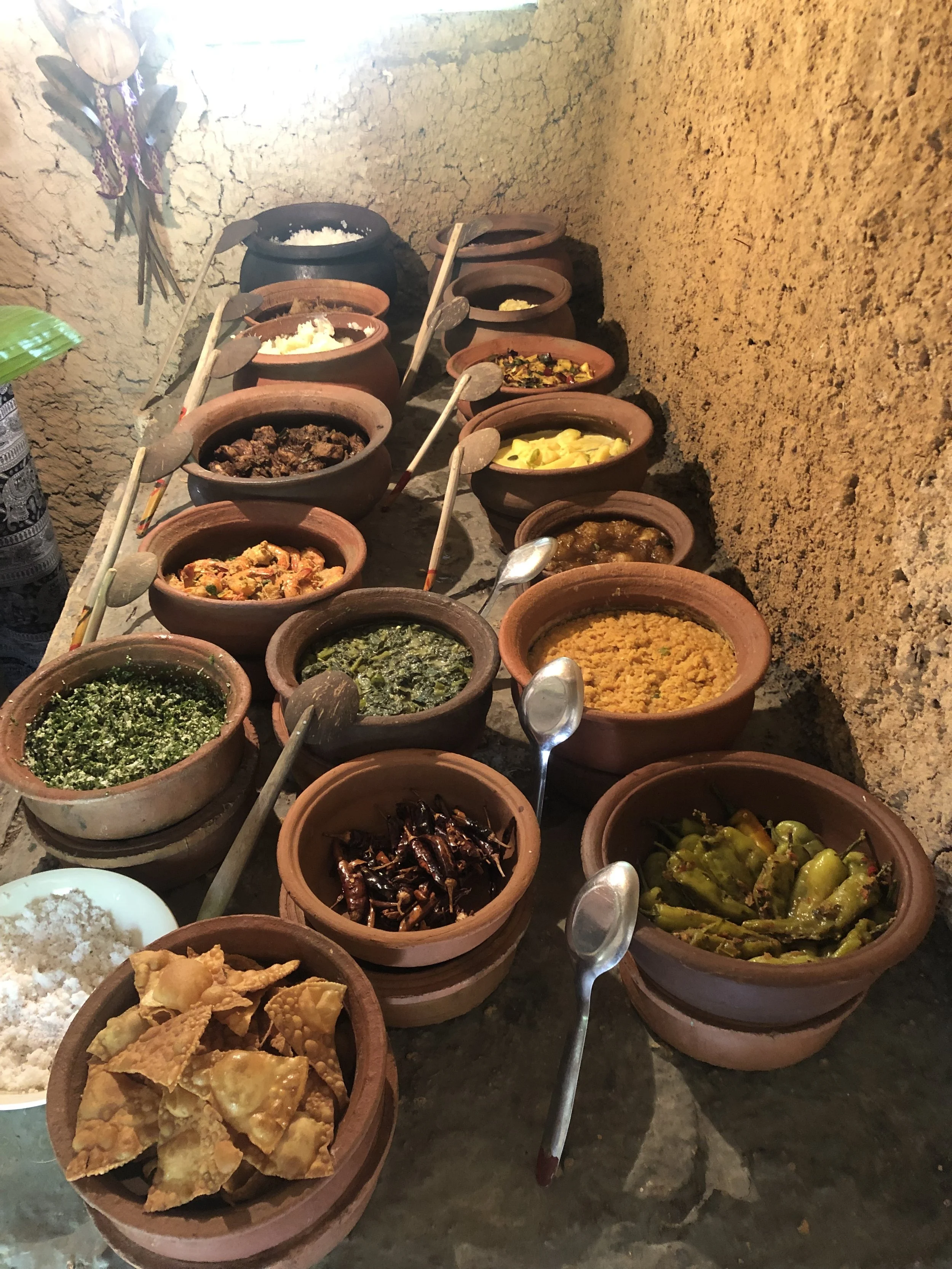
Order rice and curry anywhere along this coast and you will not be brought a plate of curry with rice beside it. You will be brought six or eight small dishes at once, with rice in the middle, and the idea is that you build each mouthful yourself.
A typical spread might hold parippu, a soft dhal in coconut milk; a malluma of finely shredded greens tossed with grated coconut and lime; a dry potato or beetroot curry; something from the sea; pol sambol, which is grated coconut pounded with chilli, lime and dried fish until it turns coral pink; a crisp papadam; a spoonful of fierce lunu miris, chilli and onion ground to a paste; and very often achcharu, a sharp pickle of carrot, onion and green chilli in vinegar and mustard that cuts through everything else on the plate.
Nothing is eaten alone. A little dhal, a pinch of sambol, a flake of fish, some rice. The combination changes with every mouthful, which is the pleasure of it.
Coconut, in almost every form
The south is coconut country, and the nut turns up at every stage of a meal.
The flesh is grated on a hiramanaya, a low stool with a serrated blade, then pressed with warm water. The first pressing is thick and is stirred in at the end of cooking so it does not split. The second, thinner, goes in at the beginning. Grated raw, it becomes sambol. Pressed into oil, it fries everything else. Sap tapped from the flower of the kithul palm becomes treacle, dark and smoky, or is boiled down harder into jaggery.
Spice, and what is done with it
Galle and Matara are among the principal districts for Ceylon cinnamon, and the bark is still peeled by hand in small workshops inland from the coast. Alongside it, a southern kitchen will keep curry leaves, rampe (pandan), lemongrass, black pepper, cardamom, clove, mustard seed, fenugreek, turmeric, tamarind and goraka, a sour dried fruit that does the work lemon does elsewhere.
Two techniques matter more than any recipe.
The first is tempering — thel dala. Oil is heated in a pan, then mustard seed, curry leaves, a piece of cinnamon and sliced onion go in and are allowed to crackle and darken before anything else joins them. It takes a minute and it is the difference between a curry that tastes flat and one that does not.
The second is how far the spices are roasted. Roasted long and dark, they make a black curry — deep, almost bitter, used for pork and for beef. Left unroasted, the same cupboard produces a white curry such as kiri hodi, a pale coconut-milk gravy with turmeric, green chilli and fenugreek that is poured over almost anything. The same ingredients, two completely different dishes.
The sea
Boats come in to the southern harbours in the morning, and the fish on the table at lunch is often what came off them: yellowfin tuna, seer fish, skipjack, prawns, crab, cuttlefish.
Fish appears in almost every form here — in a red coconut-milk curry, fried in a crust of turmeric and chilli, charred whole over coals, pounded into cutlets, or dried and salted and used as seasoning in something else entirely.
Crab is treated with particular seriousness. A southern crab curry is built in an unglazed clay pot, in a thick gravy of coconut milk and dark roasted spices, and served whole — to be taken apart slowly with your hands over the course of a long lunch. Prawns and cuttlefish get the same treatment in smaller pots.
But one dish belongs to this coast more than any other.
Fish ambul thiyal — the dish of the south
Maalu ambul thiyal, usually shortened to ambul thiyal, is the sour fish curry of southern Sri Lanka, and if you eat one traditional dish while you are here, make it this.
Firm fish — yellowfin tuna, skipjack or seer fish — is cut into thick cubes. Goraka, a sour dried fruit, is boiled soft and ground to a black paste, and that paste goes in with a quantity of coarse black pepper that looks like a mistake until you taste it. There is almost no gravy. The pot simmers until the liquid reduces right down and clings to the fish, leaving each piece dark, glossy and dry.
The result is sour first, then hot, then deeply savoury, and it is eaten in small pieces with a lot of rice because the flavour is concentrated enough to carry it.
It is also, originally, a way of keeping fish. Before refrigeration, goraka and pepper let a morning's catch sit for several days in a clay pot in a warm kitchen without spoiling. The dish is dry and intensely sour because it had to be — and that necessity produced one of the best things on the Sri Lankan table.
Breakfast is a cuisine of its own
Sri Lankan breakfast deserves its own section, because it shares almost nothing with the rest of the day.
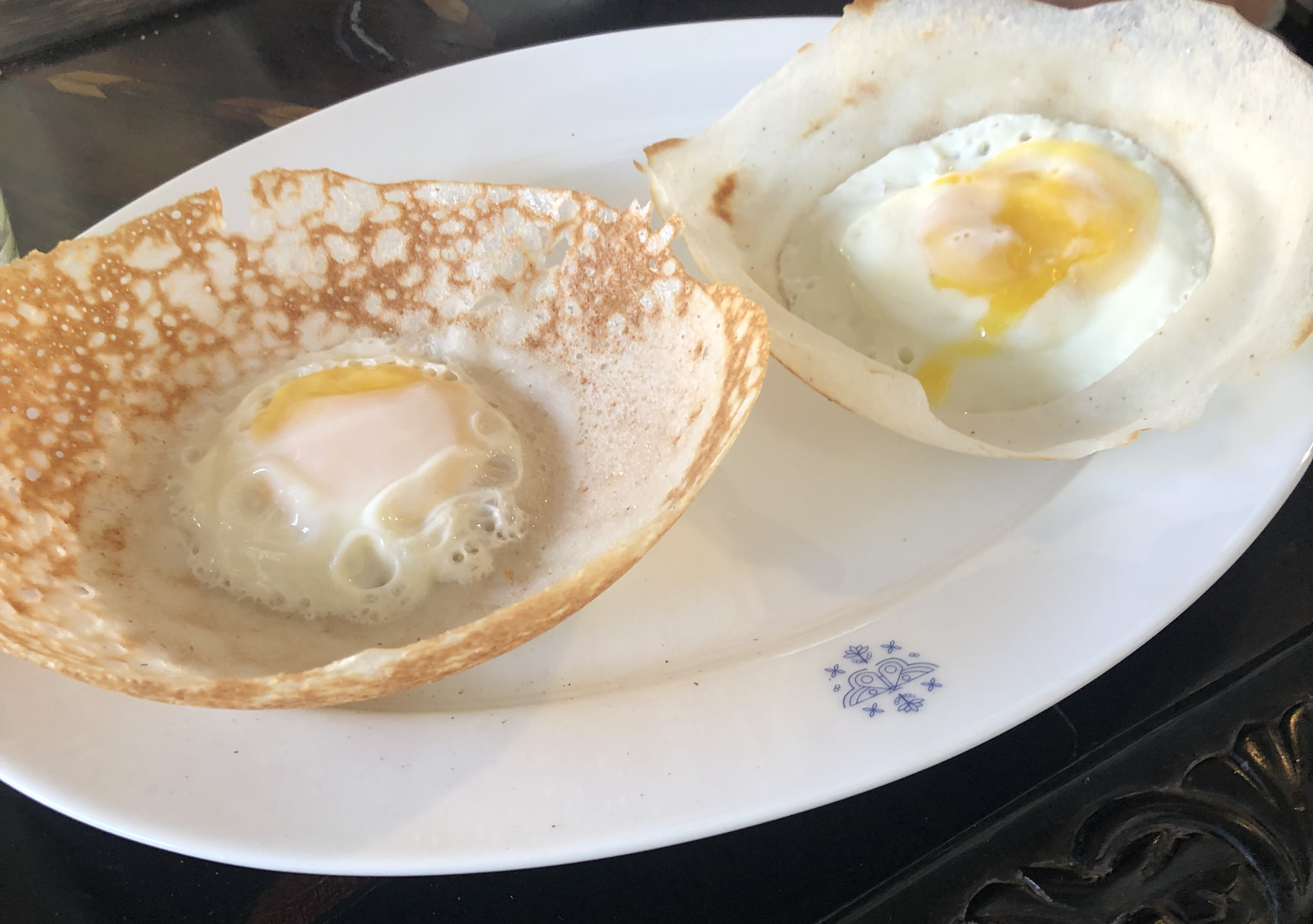
Appa — hoppers — are made from a batter of rice flour and coconut milk left to ferment overnight, then swirled into a small bowl-shaped pan so the batter climbs the sides. What comes out is a thin lacy bowl, crisp and brittle at the rim, soft and slightly sour in the middle. An egg hopper has an egg broken into the centre as it cooks.
Idiyappam — string hoppers — are a different thing altogether: rice-flour dough pressed through a sieve into fine nests and steamed. They arrive stacked, pale and soft, to be torn and dipped.
Pol roti is the plainest of the lot and possibly the most addictive. Grated coconut is worked into a simple flour dough, flattened by hand and cooked dry on a griddle until it blisters and catches in places. It is torn apart and eaten with lunu miris, and it reappears later in the day as a mid-afternoon snack.
Pittu is rice flour and grated coconut, barely moistened, steamed in a cylinder — traditionally a length of bamboo, which is where its shape comes from. It arrives as a warm crumbly column, to be broken up with thin coconut milk poured over it and a curry alongside.
Either comes with kiri hodi, pol sambol and lunu miris, and that combination of sour, sweet, coconut and chilli first thing in the morning takes most visitors one attempt to understand and then becomes the thing they miss.
On full-moon days and at new year there is kiribath, rice cooked in thick coconut milk, pressed flat and cut into diamonds.
Kottu, and the sound of the evening
As the light goes, a metallic clattering starts up outside the roadside kitchens — two blunt blades on a hot steel plate, falling in a rhythm the cook keeps up without seeming to think about it.
That is kottu. Flatbread called godamba roti is chopped on the griddle together with egg, vegetables, spices and whatever meat has been ordered, until it becomes something between a stir-fry and a hash. It was invented in the twentieth century, has no ancient pedigree whatsoever, and is now as close to a national dish as the island has. It is also the best thing to eat late.
Village cooking, and why clay matters
Away from the restaurants, the cooking is simpler and slower.
Spices are ground wet on a miris gala, a flat stone, rather than in a blender, which gives a coarser paste and a different texture in the finished dish. Curries are cooked in an unglazed clay pot, a muttiya, which heats gently, holds its heat, and over years of use gives back something of everything cooked in it before.
Village food also makes use of what grows in the garden: polos, young green jackfruit cooked until it falls apart like meat; gotu kola chopped fine into a malluma; drumsticks, breadfruit, snake gourd, cassava. It is vegetarian far more often than visitors expect, not as a choice but because that is what was to hand.
Curd, treacle and dodol
The island's best-loved dessert has two ingredients and needs nothing else.
Mee kiri with treacle (or kiri pani) — buffalo curd — is set in a shallow unglazed clay pot and sold still in it. Buffalo milk is richer than cow's milk, so the curd is thick enough to stand a spoon in, white, cool and pleasantly sour.
Over it goes treacle. Sap is tapped from the flower of the kithul palm and boiled down into a dark syrup — kithul pani — somewhere between honey and molasses, with a faint smokiness that comes from the boiling. Boiled further and set hard, the same sap becomes jaggery, sold in blocks and broken into pieces to eat with tea. Coconut palms yield a treacle of their own, pol pani, a little lighter.
Sour curd and dark sweet syrup, eaten cold from the clay at the end of a long warm lunch. It is the correct ending to a Sri Lankan meal and there is nothing to improve about it.
Dodol is the other sweet worth hunting down, and it is particularly associated with the south. Coconut milk, rice flour and kithul jaggery are cooked together over a low fire and stirred — for hours, by hand, without stopping — until the mixture darkens, thickens and finally pulls away from the sides of the pan in one glossy mass. It is poured out, left to set, and cut into dense chewy squares, sometimes with cashew running through it. The labour is the whole point, and you can taste how long it took.
Tea, and plain tea
Tea is not a southern speciality — the plantations are up in the hills — but it runs through the day everywhere on the island, and declining a cup is harder than you would expect.
Two versions matter. Kiri te is milk tea, strong and very sweet. Plain tea is black, also sweet, sometimes with a slice of lime, and is what most people drink through a working day. It comes scalding in a small glass or cup and is drunk quickly.
It is offered on arrival almost anywhere — a shop, a workshop, a neighbour's front room — and accepting it is simply the normal courtesy. Much of the everyday eating culture here happens around a glass of plain tea rather than a table.
Eating well on this coast
The short version: come hungry and eat with your hands at least once — the food is designed for it, and it genuinely tastes different.
Ask for ambul thiyal and kiri pani while you are on this coast, since this is where it belongs. Have hoppers for breakfast more than once, and pol roti with lunu miris at least once. Find kottu late in the evening. And when someone offers curd and treacle at the end of a long lunch, take it.
Royal Indigo Villa is a four-bedroom beachfront villa at Talpe, between Galle and Koggala, on the stretch of coast described above.
Disclaimer
This article is published for general information and interest only and is intended to provide basic background information about Sri Lanka’s southern coast. It reflects our understanding at the time of writing and should not be relied upon as advice or as a recommendation of any kind. Places, services, facilities, access arrangements, opening hours, transport options, local conditions and other information may change and may have changed since publication. Royal Indigo Villa does not operate or control any third-party business, operator, venue, attraction, service or form of transport mentioned or referred to in this article, and nothing in this article should be taken as an endorsement or recommendation of any such third party. Royal Indigo Villa gives no warranty that the information is complete, current or accurate and accepts no responsibility or liability for any loss, cost or inconvenience arising from its use. Please make your own enquiries and seek appropriately qualified advice where necessary before making travel plans or decisions. Nothing in this article forms part of any booking, reservation or accommodation agreement.